
PROBIT Calculator
Probability of death calculator PROBIT
Probability of Death
Our probability of death calculator, based on the Probit formula, allows you to obtain accurate estimates in seconds, thus avoiding the effort and potential errors associated with manual calculations. These results can be useful for decision-making in workshops such as What-if or HAZOP analysis, enabling you to explore different scenarios and quickly assess potential death risks. This tool provides the flexibility and agility needed to make informed safety decisions quickly and efficiently.
Probit Equation
The Probit function calculates the probability of death due to exposure to toxic substances, overpressure, and radiant heat exposure. Probit equations are based on experimental dose-response data and take the following form:
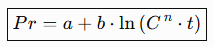
Where:
Pr = Probit
C = Represents the magnitude of the hazard
t = Explosion time
a, b, and n = Constants
The product Cn · t is often referred to as the dose factor. According to Probit equations, all combinations of concentration (C) and exposure time (t) that produce the same dose factor also yield the same Probit (Pr) value, resulting in the same expected mortality rate for the exposed population.
In the case of the Probit function for toxicity, C is the concentration of the toxic vapor in the inhaled air measured in ppm or mg/m³, the exposure time t is in minutes, and the constants a, b, and n were taken from the book «Reference Manual Beve Risk Assessment version 3.2, National Institute of Public Health and the Environment (RIVM) Centre for External Safety, 2009.»
| Substance | a (C in mg/m³) | a (C in ppmv) | b | n |
|---|---|---|---|---|
| Acrolein | -4.1 | 3.22 | 1 | 1 |
| Acrylonitrile | -8.6 | 7.52 | 1 | 1.3 |
| Ammonia | -15.6 | 16.21 | 1 | 2 |
| Arsine | -11.2 | 8.78 | 1.61 | 1.24 |
| Bromine | -12.4 | 8.54 | 1 | 2 |
| Carbon Monoxide | -7.4 | 7.21 | 1 | 1 |
| Chlorine | -6.35 | 4.81 | 0.5 | 2.75 |
| Ethylene Oxide | -6.8 | 6.16 | 1 | 1 |
| Ethyleneimine | -11.6 | 10.36 | 1.77 | 1.13 |
| Hydrogen Chloride | -37.3 | 35.62 | 3.69 | 1 |
| Hydrogen Cyanide | -9.8 | 9.43 | 1 | 2.4 |
| Hydrogen Fluoride | -8.4 | 8.62 | 1 | 1.5 |
| Hydrogen Sulfide | -11.5 | 10.76 | 1 | 1.9 |
| Methyl Bromide | -7.3 | 5.75 | 1 | 1.1 |
| Methyl Isocyanate | -1.2 | 0.57 | 1 | 0.7 |
| Methyl Mercaptan | -17.8 | 16.33 | 2.05 | 0.98 |
| Nitrogen Dioxide | -18.6 | 16.06 | 1 | 3.7 |
| Phosgene | -10.6 | 7.69 | 2 | 1 |
| Phosphine | -6.8 | 6.03 | 1 | 2 |
| Sulfur Dioxide | -19.2 | 16.76 | 1 | 2.4 |
| Tetraethyl Lead | -9.8 | 4.53 | 1 | 2 |
Table 1. Probit Constants for Toxic Substances
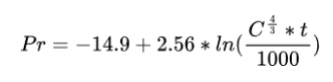
Note: The constant a from the Reference Manual Bevi Risk Assessment is similar to the values shown in the books “Yellow Book Methods for the Calculation of Physical Effects, Third Edition, 2005” and “Lees’ Loss Prevention in the Process Industries, Third Edition, Sam Mannan, 2005”. In the case of the Probit function for radiation, C is the thermal radiation given in W/m², the exposure time t is in seconds, and the constants a, b, and n were taken from the “Purple Book CPR 18E – Guidelines for Quantitative Risk Assessment, 2005”, from equation 5.4, shown in the calculator as the TNO model.

For the CCPS model, the constants were taken from the book “Guidelines for Chemical Process Quantitative Risk Analysis, Second Edition, 2000, CCPS”, from equation 2.37, shown in the calculator as the CCPS model.
Calculation of Probability of Death
Based on the Probit equation, the probability of death can be calculated using the following integral, which must be evaluated between negative infinity and the value generated by the Probit equation, denoted as Pr:
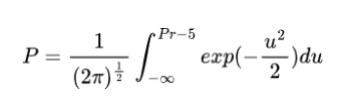
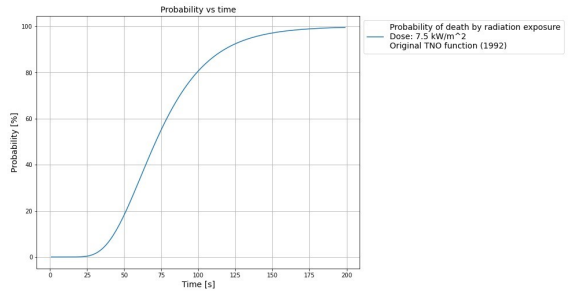
The equation for the probability of death was taken from the book “Chemical Process Safety – Fundamentals with Applications, Second Edition, Daniel A. Crowl / Joseph F. Louvar, 2002.”
How to Use
To use the toxicity calculator, you must select the substance causing toxicity, specify the amount in ppm, and the exposure time in minutes. Although the constants per product in the table are provided in mg/m³, the calculator internally converts them to ppm.